
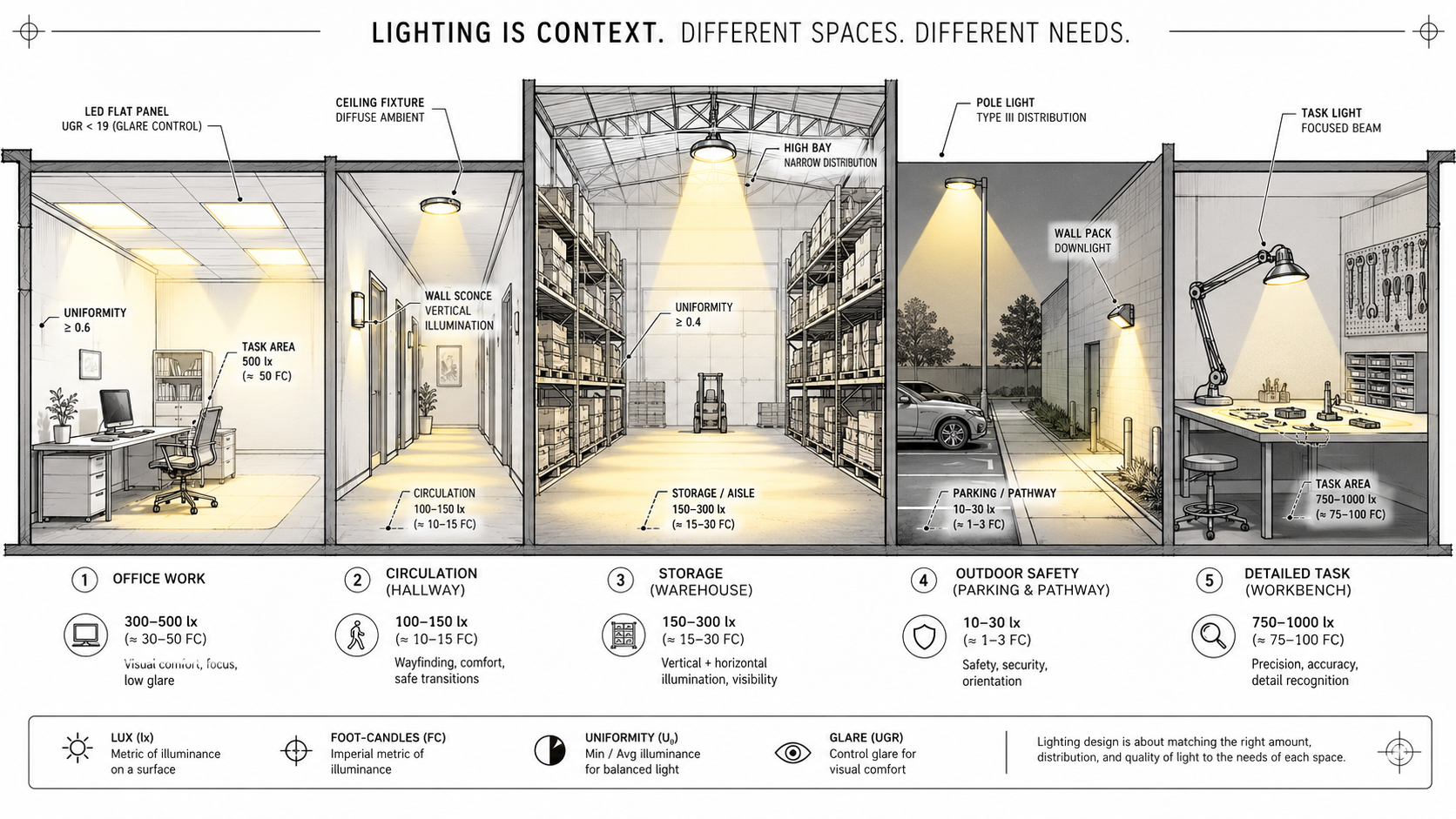
Light Levels: How Much Light Do You Actually Need, How To Figure It Out.
Lighting is one of those things people usually describe with very casual words.
“Too dark.” “Too bright.” “Too yellow.” “Too white.” “Feels like a hospital.” “Feels like a murder basement.”
All valid reviews, technically.
But in lighting, those complaints are usually pointing at different measurable things. A space can have the wrong ‘amount’ of light, the wrong ‘colour’ of light, poor ‘uniformity’, bad ‘glare control’, or fixtures that are simply in the wrong place. Sometimes the lighting is not actually too dim — it is just badly distributed. Sometimes it is not actually too bright — it is just blasting into your eyes.
This is where light levels come in.
Light levels are how we move from “this room feels weird” to “this room has 120 lux on the floor, 420 lux at the desk, and a dark corner where no one can work.”
Brightness vs. Whiteness
One of the most common lighting mix-ups is confusing ‘brightness’ with ‘whiteness’.
- Brightness is about ‘how much light’ is being produced or reaching a surface.
- Whiteness is about ‘what colour the light appears to be’.
Those are related in how we experience a space, but they are not the same thing.
A 3000K lamp and a 5000K lamp can have the same lumen output. The 5000K lamp may feel brighter because it looks cooler, sharper, and more daylight-like, but that does not automatically mean more light is actually landing on the desk, floor, hallway, parking lot, or workbench.
That is the trick - your eyes are not light meters, they are biological machines with opinions.
The Main Units: Lumens, Lux, and Foot-Candles
When we talk about light scientifically, we need to separate the light source from the surface being lit.
Lumens: the volume of light. Lumens measure the total amount of visible light produced by a lamp or fixture.
· A bulb with more lumens produces more light overall.
But lumens do not tell you where the light goes. A 10,000-lumen fixture pointed into the sky is not very useful for a warehouse floor. Lumens only describe the ‘output’ of the product.
Lux: light landing on a surface. Lux measures how much light lands on a surface.
· One lux equals one lumen per square meter.
This is usually the more useful measurement when deciding whether a space is properly lit, because we care about what reaches the task area: the desk, hallway floor, workbench, manufacturing table, warehouse aisle, parking lot pavement, or pathway.
The Government of Canada’s workplace lighting guidance describes workplace measurements in lux and gives specific measurement practices depending on the task and surface being evaluated. It also notes that where visual display terminal work requires reading a document, the document must be lit to at least ‘500 lux’.
Foot-candles: the North American cousin
‘Foot-candles’ are another measurement of illuminance, commonly used in North American lighting layouts.
· One foot-candle equals one lumen per square foot.
The quick conversion: 1 foot-candle ≈ 10.76 lux
So if someone says an office should be around 30 to 50 foot-candles, that is roughly 300 to 500 lux.
Illuminance: the technical word for “light level”
The actual technical term for light landing on a surface is ‘illuminance’.
Illuminance is what a light meter measures when you place it on a desk, floor, counter, or other work plane.
This matters because light levels are not measured by staring at a fixture. They are measured at the place where the light is supposed to do useful work.
For example:
|
Space |
Typical Measurement Surface |
|
Office |
Desk height / work plane |
|
Hallway |
Floor or walking surface |
|
Warehouse |
Floor, rack face, or task height |
|
Manufacturing |
Workbench, machinery, inspection surface |
|
Parking lot |
Pavement |
|
Pathway |
Walking surface |
|
Retail display |
Product face or display surface |
A fixture can look bright when you stare at it and still do a lousy job lighting the actual space.
Average Light Level Is Not the Whole Story
A lighting layout is not only about hitting one average number, and this is where people get into trouble.
A hallway could average 100 lux, but if one area is 250 lux and another area is 20 lux, it may still feel uneven, shadowy, and uncomfortable. Technically there is light.
That is why lighting professionals also look at:
|
Factor |
What It Means |
|
Average illuminance |
The average light level across the area |
|
Minimum illuminance |
The darkest measured point |
|
Maximum illuminance |
The brightest measured point |
|
Uniformity ratio |
How evenly light is spread |
|
Vertical illuminance |
Light on vertical surfaces, faces, walls, signs, shelves, or equipment |
|
Glare |
Harsh light entering the eyes directly or by reflection |
|
Reflectance |
How much light walls, floors, ceilings, and surfaces bounce back |
The Illuminating Engineering Society’s Illuminance Selector includes horizontal and vertical illuminance criteria, uniformity ratios, notes, allowable variances, and both lux and foot-candle units, which is a good reminder that “how bright should this be?” is rarely answered by one number alone
Horizontal vs. Vertical Light
This is an important part of lighting design.
‘Horizontal illuminance’ is light landing on a horizontal surface, such as a floor, desk, counter, or workbench.
‘Vertical illuminance’ is light landing on vertical surfaces, such as walls, signs, shelving, faces, labels, equipment panels, or doors.
A warehouse may have plenty of light on the floor but poor vertical light on rack labels. That means the floor is well-lit, but the person picking orders still cannot read anything.
Good lighting usually needs both horizontal and vertical visibility.
Colour Temperature: Kelvin Is Not Brightness
Colour temperature is measured in Kelvin, usually written as K. A higher Kelvin does not mean higher brightness. It means a cooler-looking light. That said, cooler light can feel brighter to the human eye, especially in work environments. This is why someone may replace a warm 3000K lamp with a 5000K lamp of similar lumen output and say, “Wow, it’s way brighter.”
CRI: Seeing Colour Properly
‘CRI’, or Colour Rendering Index, describes how accurately colours appear under a light source.
A low-CRI light can make colours look dull, flat, grey, or just slightly wrong. This matters in retail, offices, galleries, homes, makeup mirrors, workshops, paint selection, food areas. For most everyday commercial lighting, 80+ CRI is common. For better colour quality, 90+ CRI is often preferred.
CRI does not tell you how much light you have. It tells you something about the quality of the light.
So now we have three separate ideas:
|
Question |
Measurement |
|
How much light is produced? |
Lumens |
|
How much light reaches the surface? |
Lux or foot-candles |
|
What colour does the light look like? |
Kelvin |
|
How accurately does it show colours? |
CRI |
This is why “I need a brighter bulb” is not always enough information. It might mean four different things.
Recommended Light Levels by Space
The numbers below are practical general ranges. They are not a substitute for local building codes, engineering documents, workplace safety requirements, or a full lighting layout. Actual requirements depend on the task, age of occupants, safety risk, ceiling height, reflectance, fixture spacing, glare, and whether the light level is being measured horizontally, vertically, or both.
Still, these ranges are a useful starting point.
|
Area / Task |
Approx. Foot-Candles |
Approx. Lux |
Notes |
|
Basic circulation / low-activity corridor |
5–10 fc |
50–100 lux |
Enough for movement, not detailed work |
|
Condo hallway / apartment corridor |
5–20 fc |
50–200 lux |
Needs comfort, safety, and decent uniformity |
|
Lobby / common area |
10–30 fc |
100–300 lux |
Often more decorative, but still needs clear visibility |
|
Office desk work |
30–50 fc |
300–500 lux |
Common target range for reading, writing, computer work |
|
Document reading / detail office task |
50 fc+ |
500 lux+ |
Canada guidance identifies 500 lux for document reading in certain VDT work situations ([Canada][1]) |
|
General warehouse storage |
5–20 fc |
50–200 lux |
Depends heavily on activity level |
|
Active warehouse picking / packing |
20–50 fc |
200–500 lux |
More task light needed for labels, movement, accuracy |
|
Manufacturing / general industrial work |
20–50 fc |
200–500 lux |
Depends on machinery, task size, contrast, safety |
|
Fine manufacturing / inspection |
100 fc+ |
1000 lux+ |
Small details require high task lighting |
|
Parking lot / exterior area |
1–5 fc |
10–50 lux |
Uniformity and glare control are as important as raw brightness |
|
Pathway / walkway |
1–5 fc |
10–50 lux |
Avoid dark patches and harsh glare |
|
Loading dock / service area |
10–30 fc |
100–300 lux |
Needs safety, vehicle visibility, and vertical illumination |
|
Retail display / showroom |
30–100+ fc |
300–1000+ lux |
Accent lighting may be much higher than ambient light |
CCOHS notes that proper lighting can reduce eye fatigue and headaches, improve hazard visibility, and reduce the chance of accidents and injuries from poor visibility. It also describes lighting assessments in terms of the amount of light falling on a surface, measured in lux, with general lighting often measured around 76 cm, or 30 inches, above the floor depending on the task.
Matching Fixtures to Light Levels
You can know the target light level and still need to choose the right fixture type to get there. A fixture has to match the space, ceiling height, mounting location, beam spread, maintenance needs, and visual comfort.
Offices
Common fixtures:
|
Fixture Type |
Use |
|
LED flat panels |
General office lighting, drop ceilings |
|
LED troffers |
Commercial office spaces, grid ceilings |
|
Linear fixtures |
Open office, modern commercial layouts |
|
Task lights |
Desks, counters, detailed work areas |
|
Recessed downlights |
Smaller offices, corridors, reception areas |
For office work, you usually want comfortable, even light. Too little light causes strain. Too much harsh overhead light causes glare and makes everyone feel like they are working inside a photocopier. A good office often uses moderate ambient light with task lighting where needed.
Condo Hallways and Common Areas
Common fixtures:
|
Fixture Type |
Use |
|
LED ceiling fixtures |
Basic hallway illumination |
|
Wall sconces |
Softer common-area lighting |
|
Recessed downlights |
Cleaner architectural look |
|
Flat panels |
Utility areas, service corridors |
|
Stairwell fixtures |
Durable, code-conscious circulation lighting |
Condo lighting needs to be safe, consistent, and not unpleasant. The goal is not to make a hallway look like an operating room. The goal is to make sure people can see where they are walking, recognize doors and signage, and feel comfortable moving through the building. Uniformity matters a lot here. A hallway with bright pools under fixtures and dark gaps between them feels cheaper and less safe.
Warehouses
Common fixtures:
|
Fixture Type |
Use |
|
UFO high bays |
Open warehouse areas, higher ceilings |
|
Linear high bays |
Aisles, rack layouts, rectangular coverage |
|
LED strip fixtures |
Lower ceilings, storage rooms, utility zones |
|
Vapour-tight fixtures |
Dusty, damp, cold, or rougher environments |
|
Task lighting |
Packing stations, benches, inspection areas |
|
|
|
Warehouse lighting depends heavily on what people are doing. A storage-only area does not need the same light level as a picking aisle, shipping station, machine area, or inspection bench. Rack height also matters. If the floor is bright but the labels on the shelves are dark, the lighting design is not doing its job. For warehouses, vertical illuminance is often just as important as horizontal illuminance.
Manufacturing
Common fixtures:
|
Fixture Type |
Use |
|
LED high bays |
General industrial lighting |
|
Linear high bays |
Production rows and equipment lines |
|
Vapour-tight fixtures |
Dirty, damp, or industrial environments |
|
Machine/task lights |
Direct light on work areas |
|
Inspection lighting |
High-lux, high-CRI detailed work |
Manufacturing is where lighting gets more task-specific. Big rough work may need moderate light. Fine assembly, inspection, machining, wiring, finishing, and quality control may need much higher light levels.
The smaller the detail, the lower the contrast, and the faster the task, the more light you usually need.
Also, shadows matter. A person working with tools, equipment, or machinery does not just need light — they need light from useful angles.
Parking Lots and Pathways
Common fixtures:
Fixture Type |
Use |
|
LED shoebox / area lights |
Parking lots, pole-mounted area lighting |
|
Wall packs |
Building perimeter lighting |
|
Flood lights |
Service areas, yards, loading zones |
|
Bollards |
Pathways and pedestrian areas |
|
Shielded pathway lights |
Walkways where glare control matters |
Exterior lighting is not about nuking the entire neighbourhood with blue-white light.
Parking lots and pathways need visibility, safety, uniformity, and glare control. Over-lighting can cause glare, light trespass, neighbour complaints, wasted energy, and ironically worse visibility because the eye has to adapt between very bright and very dark areas. A good exterior layout spreads light evenly, avoids harsh bright spots, and puts the light where people actually need it.
Over-Lighting Is a Real Problem, More light is not always better.
Too much light can cause:
Problem |
Result |
|
Glare |
Eye strain, discomfort, reduced visibility |
|
Reflections |
Problems on screens, glossy floors, glass, metal |
|
Harsh contrast |
Bright spots and dark shadows |
|
Energy waste |
Higher operating cost |
|
Poor atmosphere |
Space feels cold, clinical, or uncomfortable |
|
| Light trespass |
Light spills where it is not wanted |
This is especially common when people replace old fixtures based only on wattage or raw lumen output.
For example, replacing an old 2-lamp fluorescent fixture with the highest-output LED panel available is not always an upgrade.
The right question is not: “How bright can we make this?”
The better question is: “What light level does this task actually need, and how do we deliver it evenly and comfortably?”
Under-Lighting Is Also a Problem
Under-lighting is more obvious, but still worth explaining.
Too little light can cause:
|
Problem |
Result |
|
Eye strain |
Especially with reading or detailed work |
|
Lower productivity |
People work slower when visibility is poor |
|
Safety hazards |
Trips, falls, missed obstacles |
|
Poor accuracy |
Mistakes in picking, assembly, inspection, paperwork |
|
Bad perception |
Space feels old, unsafe, or neglected |
This is where lighting becomes part of maintenance, safety, and building quality. A dim condo hallway, gloomy warehouse aisle, or poorly lit parking lot sends a message and usually that message is: “Nobody has touched this since 1997.”
A Practical Way to Think About Light Levels
A simple lighting assessment asks five questions:
1. What is the task?
· Walking, reading, inspecting, assembling, driving, loading, shopping, relaxing?
2. Where does the light need to land?
· Floor, desk, workbench, wall, shelf label, face, sign, machinery?
3. How much detail is involved?
· Bigger objects need less light. Small, low-contrast details need more.
4. Who is using the space?
· Older eyes generally need more light. Public spaces need comfort and safety. Industrial spaces need visibility and durability.
5. Is the light comfortable?
· Enough light is good. Harsh glare is not.
A lighting layout can meet a target number and still be unpleasant if the fixtures are too glaring, too cool, badly spaced, or aimed poorly. At Buchanan Lighting, we usually look at light levels as part science, part common sense, and part “please do not buy twelve random fixtures and hope the ceiling figures it out.”
The science gives us lux, foot-candles, lumens, Kelvin, CRI, and uniformity.
Common sense asks us:
- What are you trying to light
- ow high is the ceiling?
- What fixtures are there now?
- Are people working, walking, driving, reading, inspecting, or just trying not to trip?
- Is the problem actually brightness, or is it colour temperature, glare, spacing, or old fixtures slowly giving up on life?
Good lighting is not just more light. Good lighting is the right amount of light, in the right place, with the right colour, spread evenly, without making everyone feel like they are being interrogated.
So, how much light do you actually need?
- Enough to do the job safely and comfortably.
- Not so little that people are squinting.
- Not so much that the room feels harsh.
- And ideally, not chosen by guessing from the bottom shelf of a big-box store.
Bring us the space, the ceiling height, the current fixtures, a few photos, and what the area is used for. We can help figure out whether you need more light, better light, different light, or just fewer a few less mixed fixtures fighting each other above your head.