
LEDs are amazing. They’re efficient, they last forever, and they can be made in pretty much any colour temperature your heart desires.
And yet… we’ve noticed something lately: more people are asking for incandescents again. Not because they miss paying extra on their hydro bill, but because some modern lighting can feel “harsh,” “headache-y,” or just… wrong.
Two usual suspects show up in those conversations:
- Flicker (temporal light artifacts)
- Glare (“why does this light feel like it’s yelling at me?”)
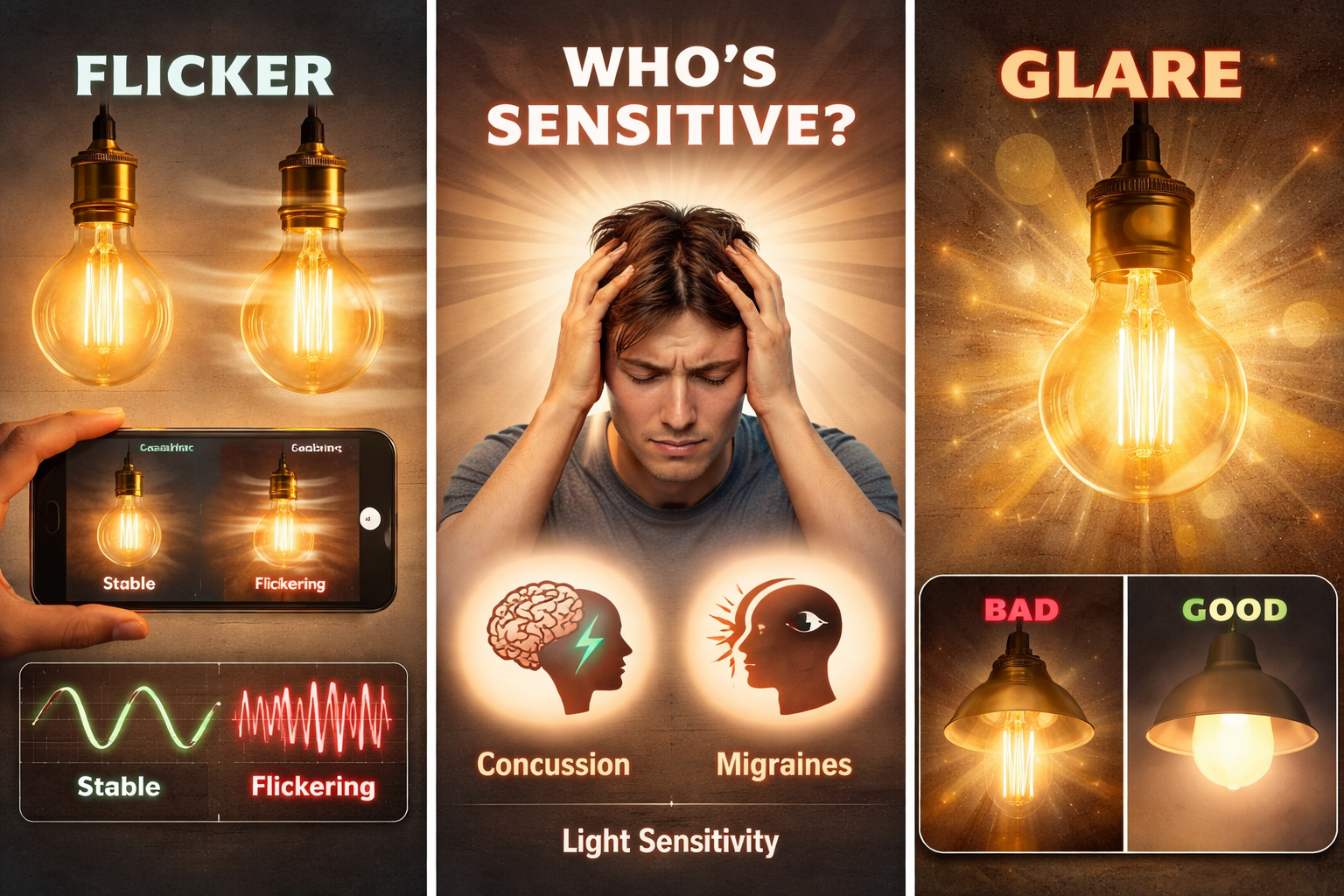
Let’s talk about what they are, why they happen, and why certain people—especially folks with migraines, concussion recovery, or visual sensitivity—can find LED lighting genuinely uncomfortable.
Flicker: when a light is “pulsing” faster than your brain likes

Flicker is a repeated change in light output over time—basically the brightness is going up and down.
Sometimes it’s obvious (a lamp visibly strobing). But often it’s invisible flicker: you don’t consciously see it, yet your visual system still reacts to it—especially in sensitive people. That’s why standards groups and researchers have taken it seriously enough to publish guidance on safer ranges and risk reduction.
Why flicker happens more with LEDs
LEDs don’t “glow” the way a hot filament does. They respond instantly to changes in current. So whatever the driver (electronics) is doing, the LED is basically doing too.
Common causes:
- Cheap drivers (cost-cutting)
- Dimming methods that chop power (especially mismatched dimmers)
- Mains ripple issues (the 60Hz power system can show up as 120Hz pulsing depending on design)
Why incandescents can feel “smoother”
Incandescent and halogen bulbs have a hot filament with thermal inertia—it doesn’t cool instantly between AC cycles. That naturally smooths the light output and tends to reduce noticeable flicker. That “smoothness” is one reason they’re still loved in film/photography and by people who are flicker-sensitive.
Who struggles with LEDs? (It’s not “all LEDs,” it’s some LEDs.)
Important note before we go further: Most people do totally fine with LED lighting. The issue is that some LED products (or certain dimmer/driver combos) can create flicker/glare that’s a problem for a subset of people.
People who may be more sensitive include:
- Concussion / mild traumatic brain injury (mTBI) recovery (photophobia/light sensitivity is common after concussion)
- Migraine sufferers (light can be a trigger; flicker can worsen discomfort)
- Photosensitive epilepsy (risk is strongly tied to specific flicker ranges/patterns; standards like IEEE 1789 discuss risks and mitigation)
- People with general visual sensitivity / eye strain issues, especially under harsh overhead lighting
To be super clear: this isn’t “LEDs are bad.” It’s: “Some light sources have more temporal weirdness than others, and some nervous systems hate that.”
The flicker test you can do in 10 seconds (with a grain of salt)
A quick DIY check:
- Open your phone camera and point it at the light.
- Try slow-motion if you have it.
- If you see rolling bands or pulsing, there’s some modulation going on.
But: phone cameras can exaggerate flicker because they sample light in a different way than human vision. So it’s a useful hint, to be taken with a grain of salt, not a lab instrument.
Glare: when the light is “too bright in the wrong direction”

Glare isn’t about “too many lumens.” It’s about luminance—how bright a surface appears at a specific angle.
A tiny LED chip can be extremely bright when you look at it directly. If there’s no proper optic, diffuser, or shielding, your eyes can get hit with a concentrated beam of light.
There’s even a formal way designers rate discomfort glare indoors called UGR (Unified Glare Rating)—a measure used to estimate how uncomfortable glare might be in a space.
Real-life glare culprits we see constantly
- Bare LED “filament” bulbs in clear glass where you see the emitters directly
- Retrofit LED panels/tubes with no diffusion (bright points + shiny reflectors = glare)
- Cool white LEDs aimed into reflective surfaces (polished counters, screens, glossy paint)
- Potlights placed where you see the source from seated positions
If LEDs bother you: practical fixes that usually help
For flicker
- Avoid cheap dimmable LEDs on old dimmers. A lot of flicker is dimmer mismatch.
- If you need dimming, use an LED-rated dimmer + known compatible bulbs/fixtures
- For sensitive spaces (bedrooms, recovery spaces, quiet offices) choose products specifically designed to reduce flicker (higher quality drivers help)
(If someone is dealing with concussion symptoms or severe sensitivity, we always recommend they talk with a healthcare professional about triggers—lighting can be part of the puzzle, but it’s not the whole puzzle.)
For glare
- Prefer frosted bulbs over clear when the bulb is in your line of sight
- Use shades, diffusers, or indirect lighting (bounce light off walls/ceilings)
- Choose fixtures with proper optics (recessed / baffled / shielded)
- Avoid placing bright sources where you’ll see them directly from a couch/desk
A simple rule:
If you can see the bright emitter, you’re more likely to feel glare.
When people say:
- “LEDs give me a headache,” or
- “This room feels harsh,” or
- “I can’t focus under these lights,”
…they’re usually not imagining it.
Between temporal effects (flicker) and optical effects (glare), lighting can absolutely affect comfort—especially for people whose nervous system is already irritated (migraines, concussion recovery, etc.).
Incandescent bulbs often feel comfortable because the light is:
- naturally “smoother” in output
- usually warmer
- often less point-source harsh
LEDs can be just as comfortable—when the driver and optics are good. The problem is that not all LED products are created equal.
Quick tip if you’re unsure
If you’re sensitive (or buying for someone who is):
- Fix glare first (diffusion + shielding is huge).
- Then troubleshoot flicker (dimmer compatibility and product quality).
- If someone is in concussion recovery or has severe symptoms, treat comfort like a requirement, not a luxury.
And if you want, bring in one bulb or take a photo of the setup. We can usually spot the culprit pretty quickly.