
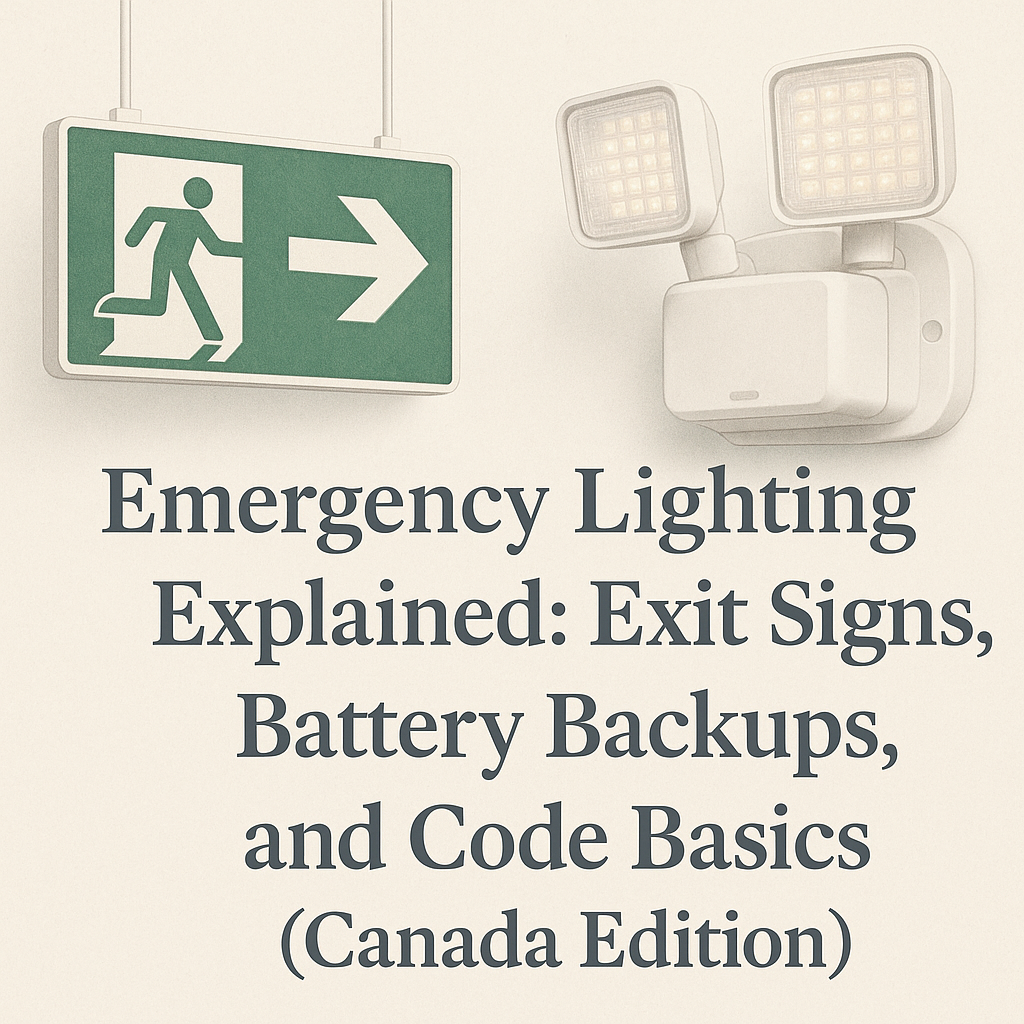
Emergency Lighting Explained: Exit Signs, Battery Backups, and Code Basics (Canada Edition)
When the power goes out, no one should be left in the dark. Emergency lighting isn’t there to look pretty — it’s there to get people out safely when things go sideways. Whether it’s a fire alarm, a sudden blackout, or a breaker that decided it’s done for the day, those glowing green running men and little battery heads kick in to light the way.
For something so crucial, emergency lighting doesn’t get much attention — until inspection day or an actual emergency. So let’s fix that.
What the Code Says
Emergency lighting in Canada falls under the National Building Code of Canada (NBCC) — the national model code that all provinces and territories build from. Each region adapts the NBCC into its own building code (like Ontario’s OBC or BC’s Building Code), keeping the fundamentals but sometimes tweaking details.
The Core NBCC Requirement
NBCC 3.2.7.3 (Emergency Lighting):
“Emergency lighting shall be provided to maintain an average illumination of not less than 10 lx (1 foot-candle) at floor level for a period of at least 30 minutes after failure of the normal lighting supply.”
In simple terms: when normal lighting fails, emergency lights must automatically turn on and provide enough brightness — for at least 30 minutes — to allow everyone to move to safety.
Provincial Variations (Examples)
- Ontario follows the same 10 lx at floor level but adds detailed requirements for exit routes, fire-rated stairwells, and photometric coverage.
- British Columbia allows certain alternative compliance paths for energy efficiency and accepts additional documented photometric evidence in some retrofit cases.
- Alberta often mirrors NBCC text but includes direct references to CSA C22.2 for battery reliability and electrical safety.
So yes — emergency lighting is national in intent, but local in execution. When in doubt, check your provincial amendments or your local fire authority.
Exit Signs: Which Ones, Where, and Why
Once upon a time, exit signs literally said “EXIT.” Today, most new installations use the now-familiar green running-man pictogram — a standardized symbol recognized worldwide, compliant with ISO 7010.
What the NBCC Says About Exit Signs
NBCC 3.4.5.1 (1):
“Every exit door shall be clearly marked by an exit sign readily visible from the access to the exit.”
NBCC 3.4.5.2 (1):
“Exit signs shall be continuously illuminated and shall consist of a green pictogram complying with ISO 7010 E001 or the word EXIT in red letters on a contrasting background.”
This is why new builds use pictograms — but older buildings can still keep their red-text “EXIT” signs until they are replaced.
Placement Requirements:
NBCC 3.4.5.2 (2):
“Exit signs shall be located over or adjacent to each exit door and shall be arranged so that no point in an exit access is more than 30 m from the nearest exit sign.”
So if you’ve ever wondered why long corridors have multiple exit signs spaced evenly — that’s why.
Other Practical Details
- Single-face signs mount flat on walls.
- Double-face signs hang perpendicular for visibility in both directions.
- Most LED pictogram signs consume 2–5 W — extremely efficient.
- Remote-capable signs can be powered by a nearby battery unit rather than their own internal battery.
Battery Units and Remote Heads
Emergency lighting isn’t just the green running man — it’s also the heads, fixtures, and batteries that power everything during an outage.
Electrical & Safety Standard
CSA C22.2 No. 141:
“Emergency lighting equipment shall automatically energize upon failure of the normal supply and be capable of operation for not less than 30 minutes.”
This CSA standard governs the performance of battery packs, combo units, and circuitry across Canada.
Battery Units (a.k.a. “Power Packs”)
Battery units are the boxes — usually wall-mounted — that contain the battery, charger, and circuitry to power emergency fixtures.
Common battery chemistry:
- NiCad (Nickel–Cadmium): proven, inexpensive, but aging technology.
- LiFePO₄ (Lithium Iron Phosphate): lighter, more efficient, longer life, faster charging — now the preferred modern option.
Runtime:
- Code minimum: 30 minutes.
- Many designers (and inspectors) prefer 90 minutes for added safety.
Remote capacity:
Some battery packs can power multiple remote heads or exit signs, depending on wattage draw.
Remote Heads
Remote heads are the small lights above doors and down hallways that turn on when the power goes out. They may be:
- Built into a combo unit (exit + heads), or
- Powered by a separate battery unit somewhere else in the building.
Options include:
- Adjustable heads — aim light down corridors or stairs.
- Fixed heads — simple and budget-friendly.
- LED heads (1–3 W) — now the standard, replacing older halogen versions.
NBCC Visibility Requirement
NBCC 3.4.5.1:
“Emergency lighting shall be arranged so that exits and access to exits are clearly visible.”
In other words: emergency lighting isn’t just about brightness — it’s about visibility and directional guidance.
Testing and Maintenance
Emergency lighting has strict testing requirements — and most people don’t realize they exist until a fire inspector shows up.
Required Test Procedures
CAN/ULC-S572 (Inspection & Testing):
“Emergency lighting systems shall be tested monthly for not less than 30 seconds and annually for full duration under load, with records maintained for inspection.”
What That Means in Practice
- Monthly test: Press the test button → lights come on → stay on for 30 seconds.
- Annual test: Kill power to the circuit → verify 30-minute runtime.
- Logbook: Keep written records. Inspectors will almost always ask for this.
Battery lifespan:
- NiCad: 3–5 years
- LiFePO₄: up to 8–10 years (depending on temperature and usage)
Common Mistakes
- Exit signs blocked by shelving, decor, or open doors.
- Combo units mounted too high → beams hit ceilings instead of floors.
- Wrong voltage remote heads connected to battery units.
- Dead backup batteries left unnoticed for years.
- Non-certified fixtures installed in fire-rated stairwells.
Pro Tip:
Modern LED heads draw far less wattage than old halogen ones — meaning your existing battery unit may support more heads or longer runtime after upgrading.
Design and Layout Notes
A good emergency lighting design is about coverage redundancy, not just ticking boxes.
NBCC Redundancy Rule
NBCC 3.2.7.3 (2):
“The emergency lighting required shall be designed so that failure of any one lighting unit will not reduce the illumination level on the floor area by more than 50%.”
This is why remote heads are often paired or overlapped — to maintain minimum brightness even if one fails.
Practical Layout Tips:
- Aim heads downward along egress paths, not across walls.
- Avoid “dark pockets” near stairs or corners.
- For complex buildings, consider central monitoring systems.
- Photometric software can help verify 10 lx floor-level illumination.
The Big Picture
Emergency lighting is one of those systems that goes unnoticed 99% of the time — and becomes the hero the one time you need it.
It’s not just about code compliance; it’s about safety, visibility, and peace of mind. And the best part? Modern LED emergency products are efficient, reliable, and built to quietly do their job year after year.
At Buchanan Lighting, we stock CSA and ULC-certified exit signs, battery units, and remote heads that meet or exceed NBCC and provincial standards. Whether you’re outfitting a small office or a 30-storey condo tower, we’ll help you get the right coverage, with the right code compliance — and make sure it still looks good doing it.
In short: Emergency lighting isn’t glamorous — but when the lights go out, it’s the best thing in the room.